Mares P. W.

God’s Gift

IMO “Danya”

A chess elegy on the living move, the later record, and the human cost of public judgment.

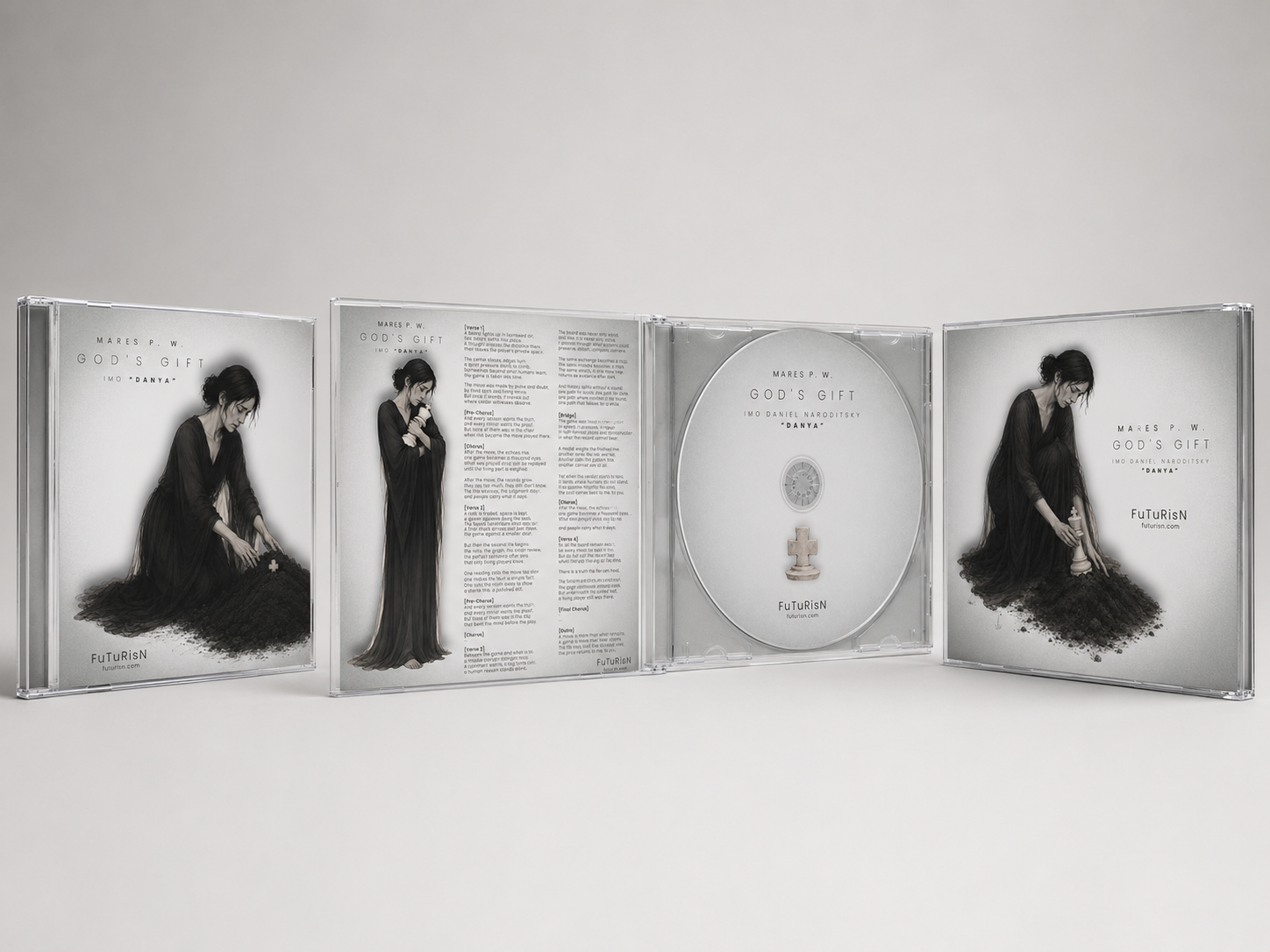
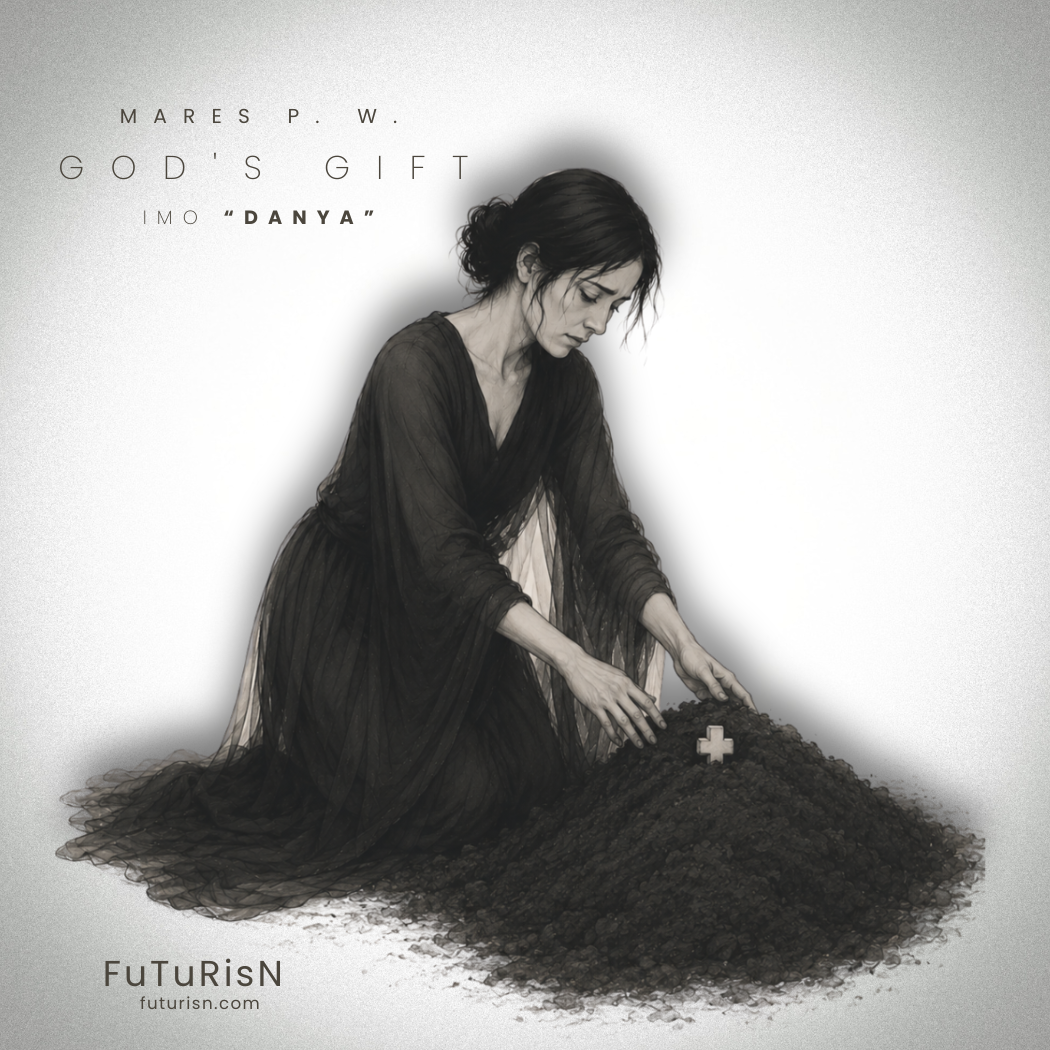
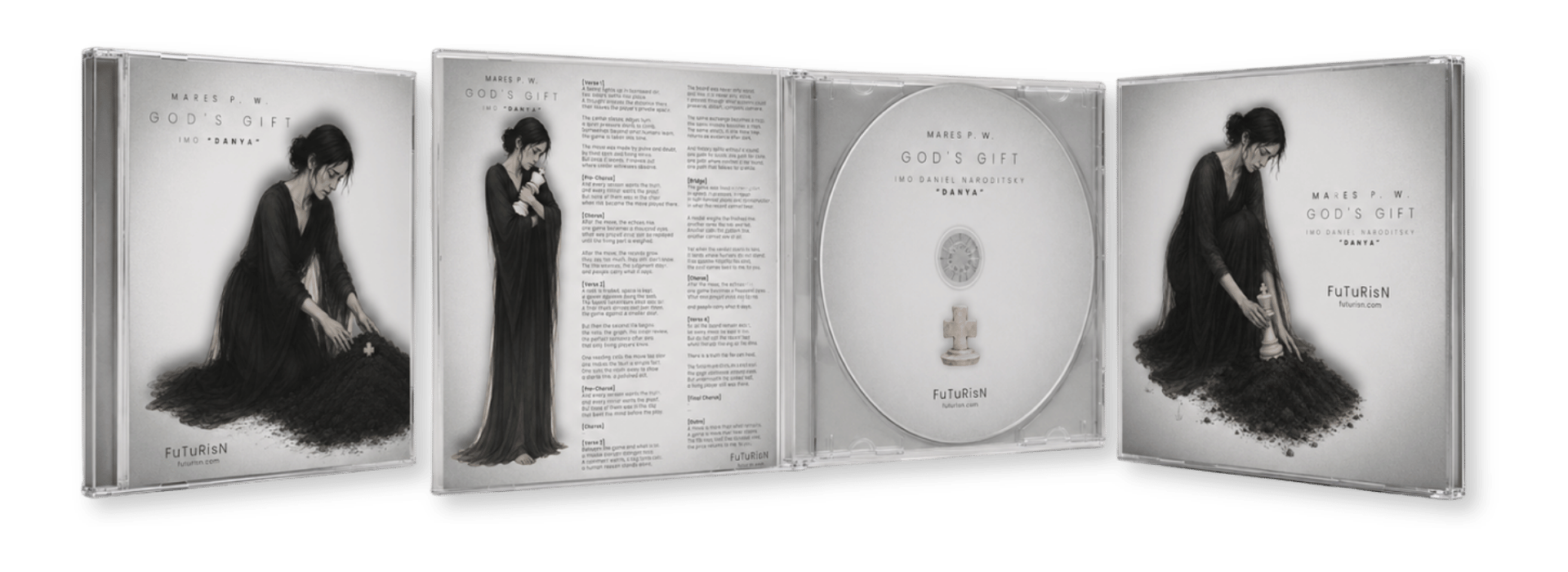
God’s Gift front cover

What triggered it

Danya's Statements

“So the fact that this has been going on for as long as it has been is deeply frustrating to me, and not because it's me personally; if I depersonalize myself, it's a great shame. So when the history of chess is going to be written, this will be a very, very dark chapter, and it'll be a dark chapter not just because Vlad has been allowed to go on with his nonsense for as long as he has, but because behind the scenes some top players are not outspoken enough to make it clear that the patients are not running the insane asylum. So it is shameful that I'm sort of involved in this, embroiled in this.”

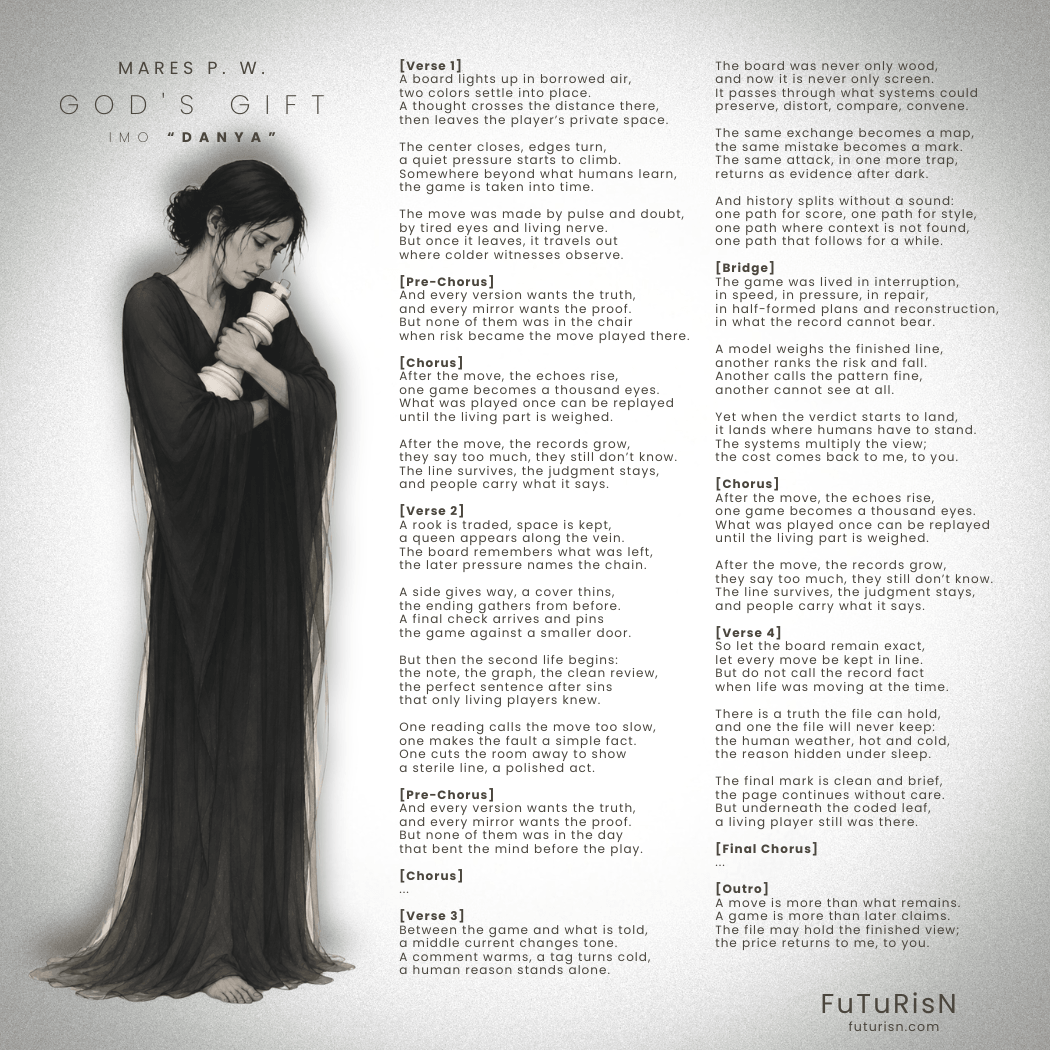
Complete lyrics

God’s Gift

[Verse 1]
A board lights up in borrowed air,
two colors settle into place.
A thought crosses the distance there,
then leaves the player’s private space.

The center closes, edges turn,
a quiet pressure starts to climb.
Somewhere beyond what humans learn,
the game is taken into time.

The move was made by pulse and doubt,
by tired eyes and living nerve.
But once it leaves, it travels out
where colder witnesses observe.

[Pre-Chorus]
And every version wants the truth,
and every mirror wants the proof.
But none of them was in the chair
when risk became the move played there.

[Chorus]
After the move, the echoes rise,
one game becomes a thousand eyes.
What was played once can be replayed
until the living part is weighed.

After the move, the records grow,
they say too much, they still don’t know.
The line survives, the judgment stays,
and people carry what it says.

[Verse 2]
A rook is traded, space is kept,
a queen appears along the vein.
The board remembers what was left,
the later pressure names the chain.

A side gives way, a cover thins,
the ending gathers from before.
A final check arrives and pins
the game against a smaller door.

But then the second life begins:
the note, the graph, the clean review,
the perfect sentence after sins
that only living players knew.

One reading calls the move too slow,
one makes the fault a simple fact.
One cuts the room away to show
a sterile line, a polished act.

[Pre-Chorus]
And every version wants the truth,
and every mirror wants the proof.
But none of them was in the day
that bent the mind before the play.

[Chorus]
After the move, the echoes rise,
one game becomes a thousand eyes.
What was played once can be replayed
until the living part is weighed.

After the move, the records grow,
they say too much, they still don’t know.
The line survives, the judgment stays,
and people carry what it says.

[Verse 3]
Between the game and what is told,
a middle current changes tone.
A comment warms, a tag turns cold,
a human reason stands alone.

The board was never only wood,
and now it is never only screen.
It passes through what systems could
preserve, distort, compare, convene.

The same exchange becomes a map,
the same mistake becomes a mark.
The same attack, in one more trap,
returns as evidence after dark.

And history splits without a sound:
one path for score, one path for style,
one path where context is not found,
one path that follows for a while.

[Bridge]
The game was lived in interruption,
in speed, in pressure, in repair,
in half-formed plans and reconstruction,
in what the record cannot bear.

A model weighs the finished line,
another ranks the risk and fall.
Another calls the pattern fine,
another cannot see at all.

Yet when the verdict starts to land,
it lands where humans have to stand.
The systems multiply the view;
the cost comes back to me, to you.

[Chorus]
After the move, the echoes rise,
one game becomes a thousand eyes.
What was played once can be replayed
until the living part is weighed.

After the move, the records grow,
they say too much, they still don’t know.
The line survives, the judgment stays,
and people carry what it says.

[Verse 4]
So let the board remain exact,
let every move be kept in line.
But do not call the record fact
when life was moving at the time.

There is a truth the file can hold,
and one the file will never keep:
the human weather, hot and cold,
the reason hidden under sleep.

The final mark is clean and brief,
the page continues without care.
But underneath the coded leaf,
a living player still was there.

[Final Chorus]
After the move, the echoes rise,
one game becomes a thousand eyes.
What was played once can be replayed
until the living part is weighed.

After the move, the records grow,
they say too much, they still don’t know.
The line survives, the judgment stays,
and people carry what it says.

[Outro]
A move is more than what remains.
A game is more than later claims.
The file may hold the finished view;
the price returns to me, to you.

Literary analysis

A living move after it leaves the chair

The title names the person

God’s Gift is not a general metaphor floating above the song. The gift is Danya: the living, gifted chess mind whose play, speech, pressure, vulnerability, and public burden stand at the center of the release. The phrase carries admiration and grief at the same time. A gift can be recognized too late, mishandled by the structures around it, or reduced by spectators to the record it leaves behind.

Naroditsky adds a second layer. Heard through its Slavic field, the name touches narod, people or nation, and the older semantic family of birth, parentage, origin, and lineage. The release therefore reads the player through birth and belonging before it reads him through controversy. It restores personhood before analysis begins.

The central fracture

The song is built around a fracture between the lived move and the later object made from it. During the game, a move belongs to pulse, doubt, time pressure, fatigue, partial repair, and a mind working from inside risk. Afterward it enters a second life: notation, file, replay, graph, comment, accusation, verdict, memory. The lyric keeps those two lives visible at once.

The repeated line “after the move” is the hinge. It marks the instant where action leaves the player and becomes available to systems that can preserve it, circulate it, simplify it, weaponize it, or canonize it. The song’s pressure comes from that transformation.

The neglected part of the statement

The trigger passage is not merely about one controversy. Its force lies in the attention Danya gives to institutional failure, historical residue, and the silence of stronger voices. He describes a failure of public naming: a situation that continues because the people with enough weight to interrupt it leave too much unnamed. The single answers that structure, placing responsibility around the record rather than inside gossip.

That is why the lyrics keep returning to witnesses, mirrors, proof, files, models, comments, tags, and verdicts. The problem is an ecosystem of later reading. Once the move becomes replayable, every viewer can appear more certain than the person who had to live the position from the chair.

The board as record, screen, and court

The board begins as a material field: two colors, center, edge, rook, queen, check. By the third verse it has become screen, map, mark, evidence, and history. This development matters because the song treats chess as a place where human action becomes data without losing its human origin. The board remains exact; the interpretation around it becomes morally unstable.

“Let every move be kept in line” accepts the need for precision. “Do not call the record fact when life was moving at the time” places a boundary around what precision can claim. A PGN can preserve sequence. It cannot preserve heat, fear, exhaustion, recovery, disturbance, responsibility, silence, or the social weather around the move.

The elegiac object

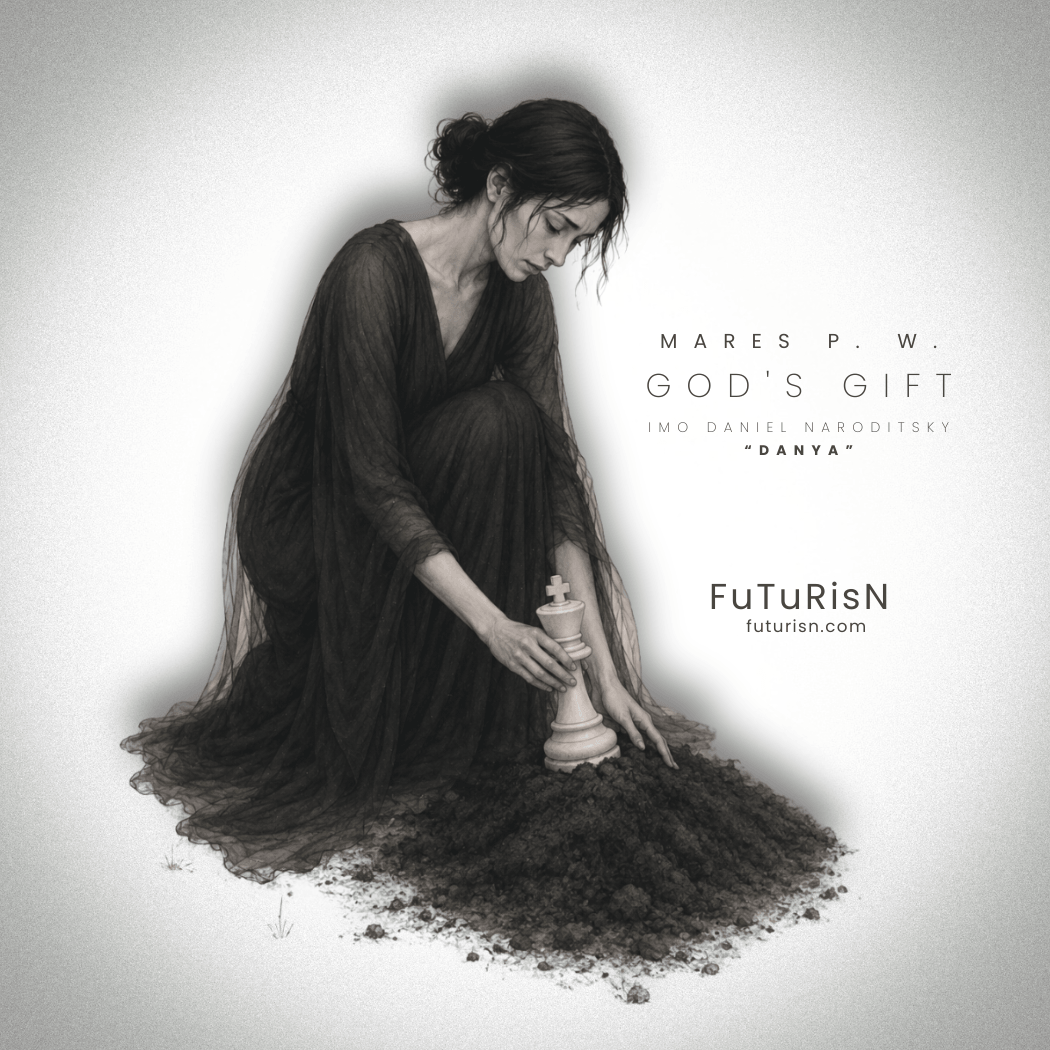
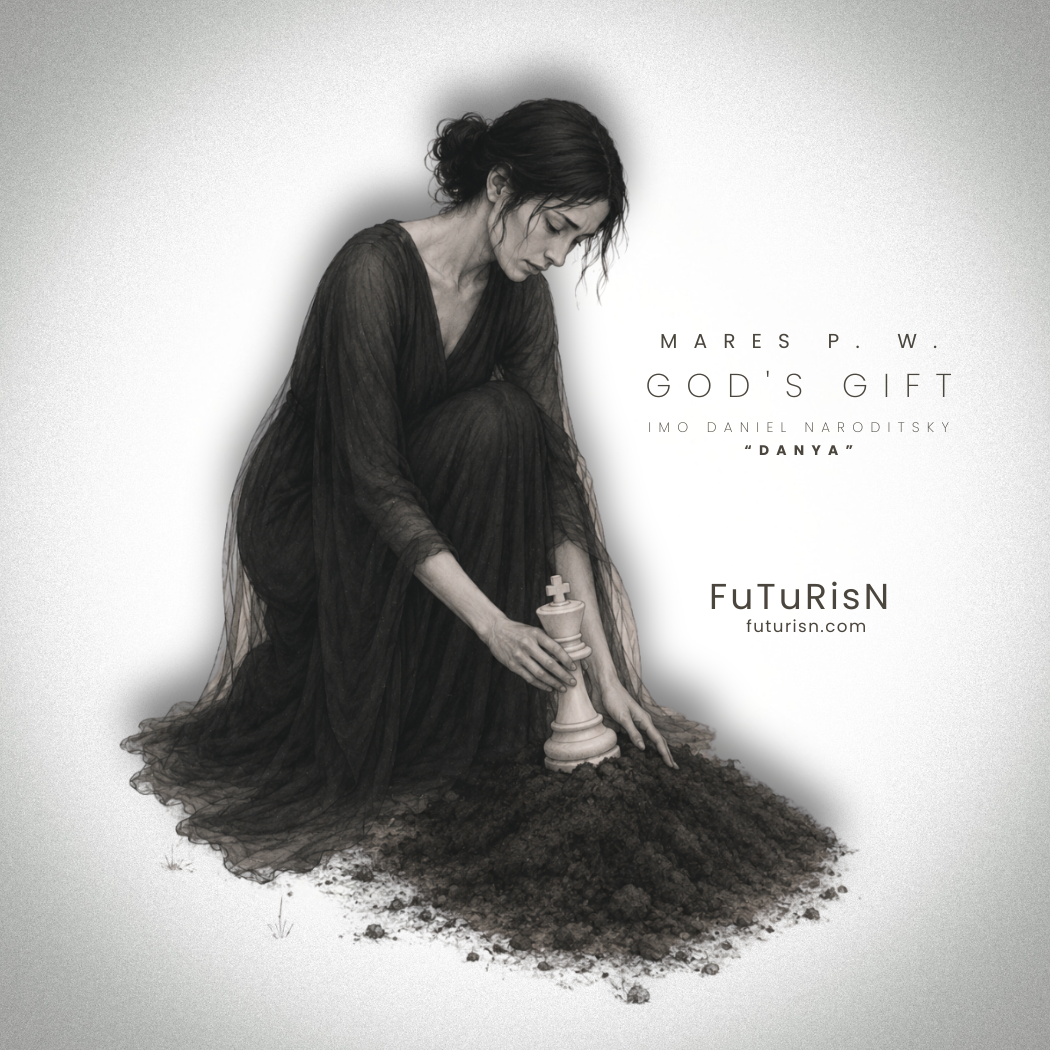
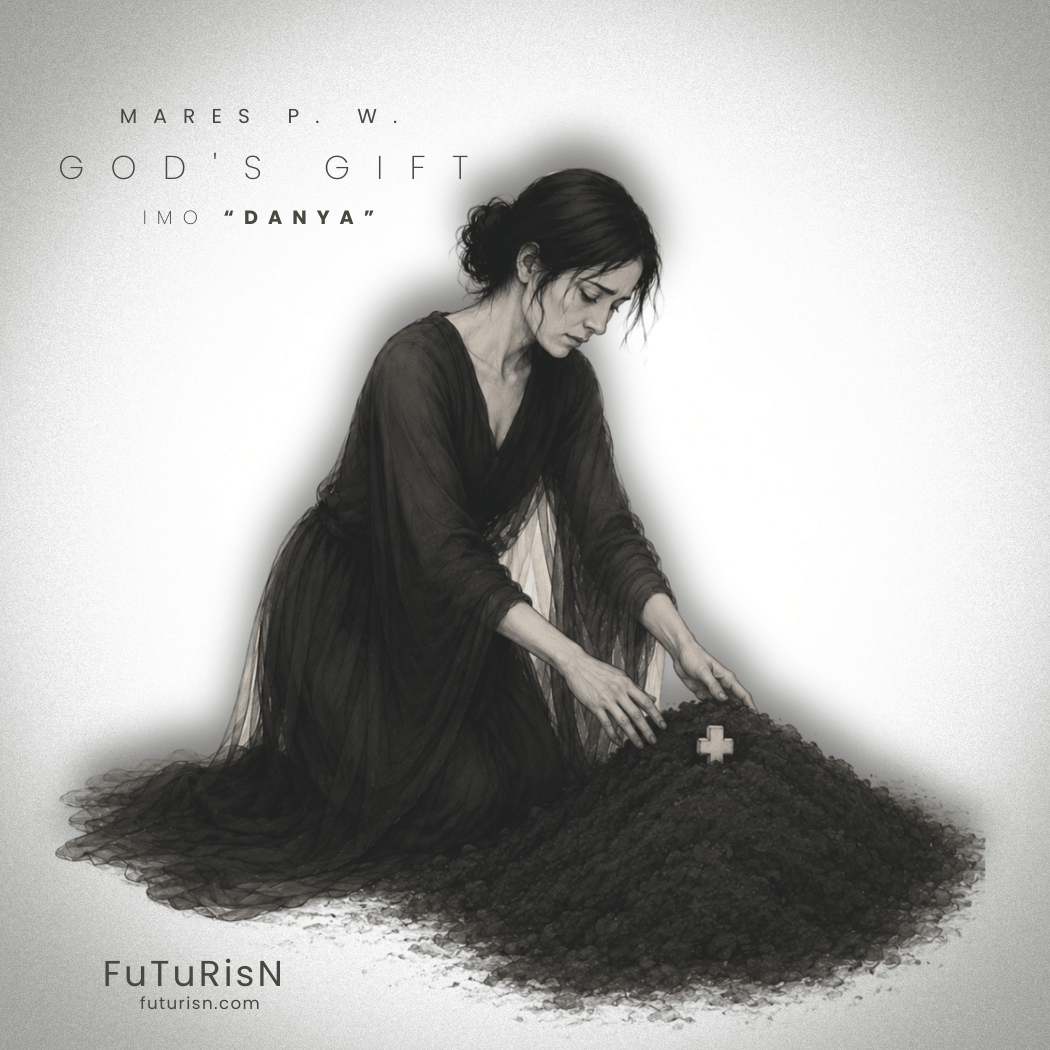
The visual system extends the lyric. The cross-shaped chess piece is no longer only a piece. It becomes marker, grave, memorial, and final evidence. The woman in black does not dramatize scandal; she holds the cost. The dirt is the place where analysis arrives too late, where a clean line has already buried the living interval that produced it.

The title God’s Gift carries this contradiction through Danya himself: the gift is the person before it is the performance. Talent can be treated as sacred when admired and disposable when exposed to public machinery. The tribute format turns that contradiction into a sober memorial object: cover, disc, booklet, video, lyric, and song form one coherent artefact.

The final ethical turn

The outro refuses to let the file have the last word. “A move is more than what remains” is the governing claim of the whole release. The song does not ask the record to disappear. It asks the listener to stop confusing the finished view with the whole event.

The final address, “to me, to you,” expands the cost. The price returns to players, commentators, institutions, spectators, archivists, and anyone who benefits from a clean record while ignoring the living conditions that made the record possible.
↑